

.webp)


.svg)

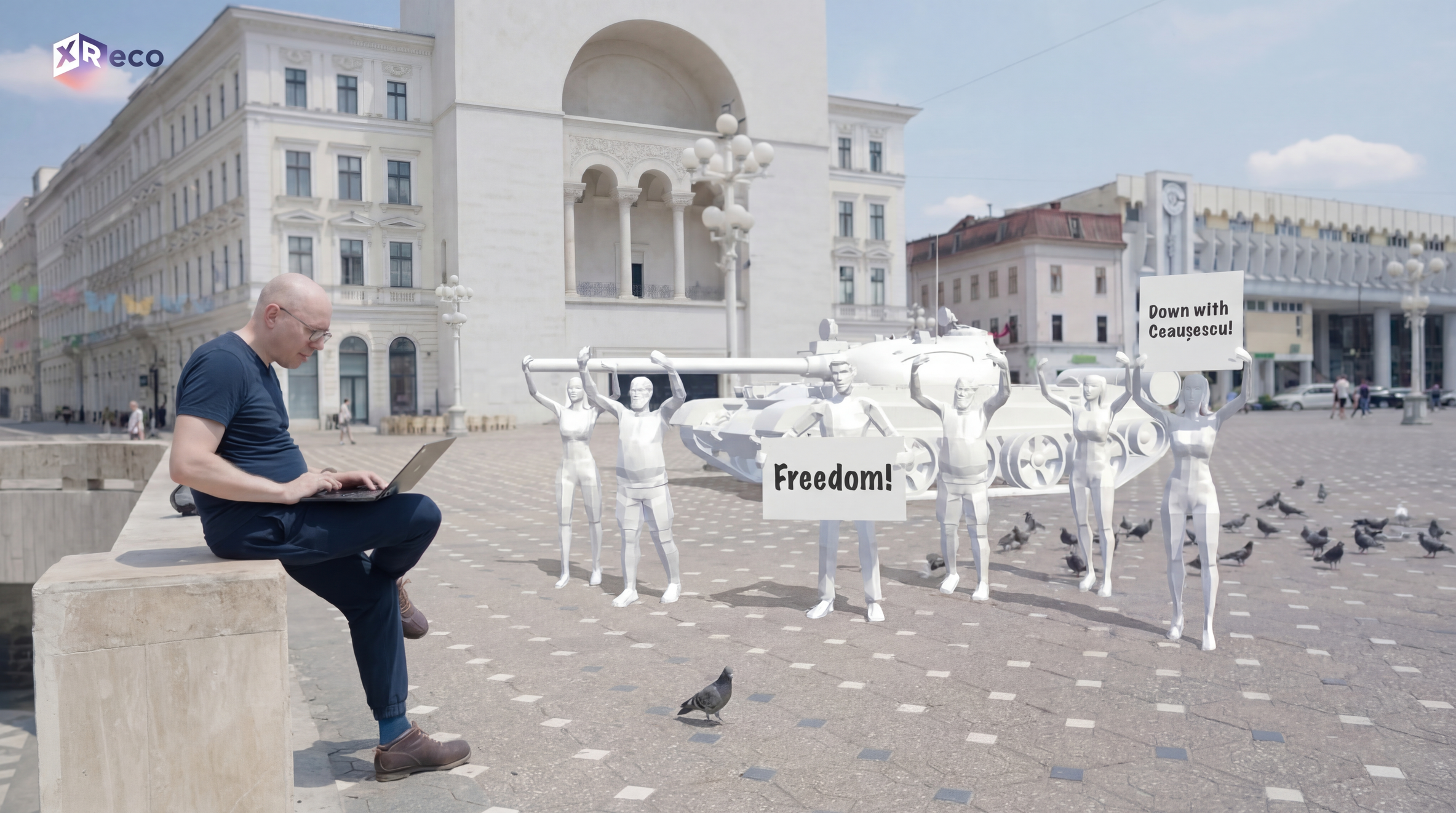
Augmented reality has huge promise, but in practice AR projects are often slow, expensive and locked inside bespoke apps. Every new tour or installation can feel like starting from scratch: new code, new app store listing, new learning curve for visitors. Within the Horizon Europe project XReco (Grant Agreement ID: 101070250), the consortium set out to change that by building an XR media ecosystem and tooling that make immersive experiences easier to create, manage and distribute. ZAUBAR’s role in this European team of broadcasters, research institutions, technology providers and mobility companies is to bring in deep experience with location-based augmented reality and turn it into something reusable: an XR-first content management system.
XReco aims to treat XR not as isolated demos, but as a persistent media layer that can live on top of cities, vehicles and cultural spaces. Partners are developing tools and workflows that let creators work with 3D assets, volumetric humans, spatial audio and AI-generated content as easily as they handle video or text today.
ZAUBAR’s Location-Based XR CMS
ZAUBAR’s main contribution within XReco is an XR-first content management system tailored to location-based AR tours. Instead of managing pages and posts, this CMS manages places, routes and “moments in space”: a guide in a square, a 3D reconstruction on a façade, an audio story that unfolds along a riverbank or inside a moving vehicle.
Curators and editors use a browser interface to upload photos, videos and 3D assets, define scenes, anchor them to GPS coordinates and choreograph how an experience unfolds as a visitor moves through a city or venue. For precise alignment in streets, plazas and exhibition spaces, the platform combines GPS with a Visual Positioning System (VPS) that uses camera images to localise the device against known reference points. This ensures that digital objects reliably “stick” to façades and squares, even when GPS is noisy or visitors return to the same spot on another day. Updates are deployed in real time, so copy can be refined and new stops added without touching app code or vehicle software. That makes the system practical for museums, tourism boards and media organisations that need to keep stories current rather than freezing them in a one-off app build.
To make XR production feasible at scale, the CMS is integrated with generative and spatial computing tools explored in XReco. Existing photos, videos and archival documents can be turned into AR-ready scenes with far less manual work than traditional 3D pipelines. Neural rendering supports detailed 3D views of landmarks, volumetric capture lets real people appear as lifelike “holograms”, and AI-assisted tools support scripting, localisation and narrative design, keeping human editorial judgment at the centre while lowering technical barriers.
Experiences built through the CMS can be delivered as WebAR in the browser or via lightweight Instant Apps and App Clips. Immersive tours open with a tap on everyday devices, whether that is a smartphone, a tablet or a compatible in-car infotainment system.
From Platform to Use Case: Timișoara as an Example
One of the consortium’s demonstrators that puts this platform to the test is an in-car AR tour in Timișoara, Romania. Developed jointly by XReco partners, it uses ZAUBAR’s CMS as the backbone for a documentary-style route through the city inside a Continental-equipped vehicle. On a curated drive, the system fades in archival audio, overlays historical imagery and brings in volumetric recordings of historians and eyewitnesses at the right locations. For the consortium, this use case shows that the same technical foundation can power walking tours, museum visits and in-car experiences without changing the underlying tooling.
Collaboration, Funding and What Comes Next
The Timișoara in-car tour is one of several demonstrators within XReco, which is co-financed by the European Commission under the Horizon Europe programme.The consortium includes Atos, Continental Industry, Deutsche Welle, Fincons Group, i2CAT Research Centre, JOANNEUM RESEARCH, KU Leuven, Moog Inc., NVIDIA, Rai – Radiotelevisione Italiana, Sound, Universidad Politécnica de Madrid, Capgemini Engineering, XRBB – Extended Reality Berlin-Brandenburg e.V., VISYON, University of Basel, the Centre for Research & Technology Hellas (CERTH), Theódoros Chíou and ZAUBAR. Their combined expertise in media, mobility, research and technology ensures that the tools being built are grounded in real use cases and user needs.
For ZAUBAR, participating in XReco is a milestone and a launchpad. The project shows how an AR-first CMS, AI-assisted creation workflows and location-based storytelling can come together in experiences that are ready for real visitors, not just lab prototypes. It also points to what comes next for the consortium: more cities, more formats and more partners using the same toolkit to build location-based AR tours. The ride through Timișoara is a glimpse of that shared future – an example of how XReco’s technology stack and collaborative approach can turn any place, and any journey, into a story worth exploring.



.svg)
.svg)
.svg)
.svg)

%201.svg)

.webp)


