

.webp)


.svg)

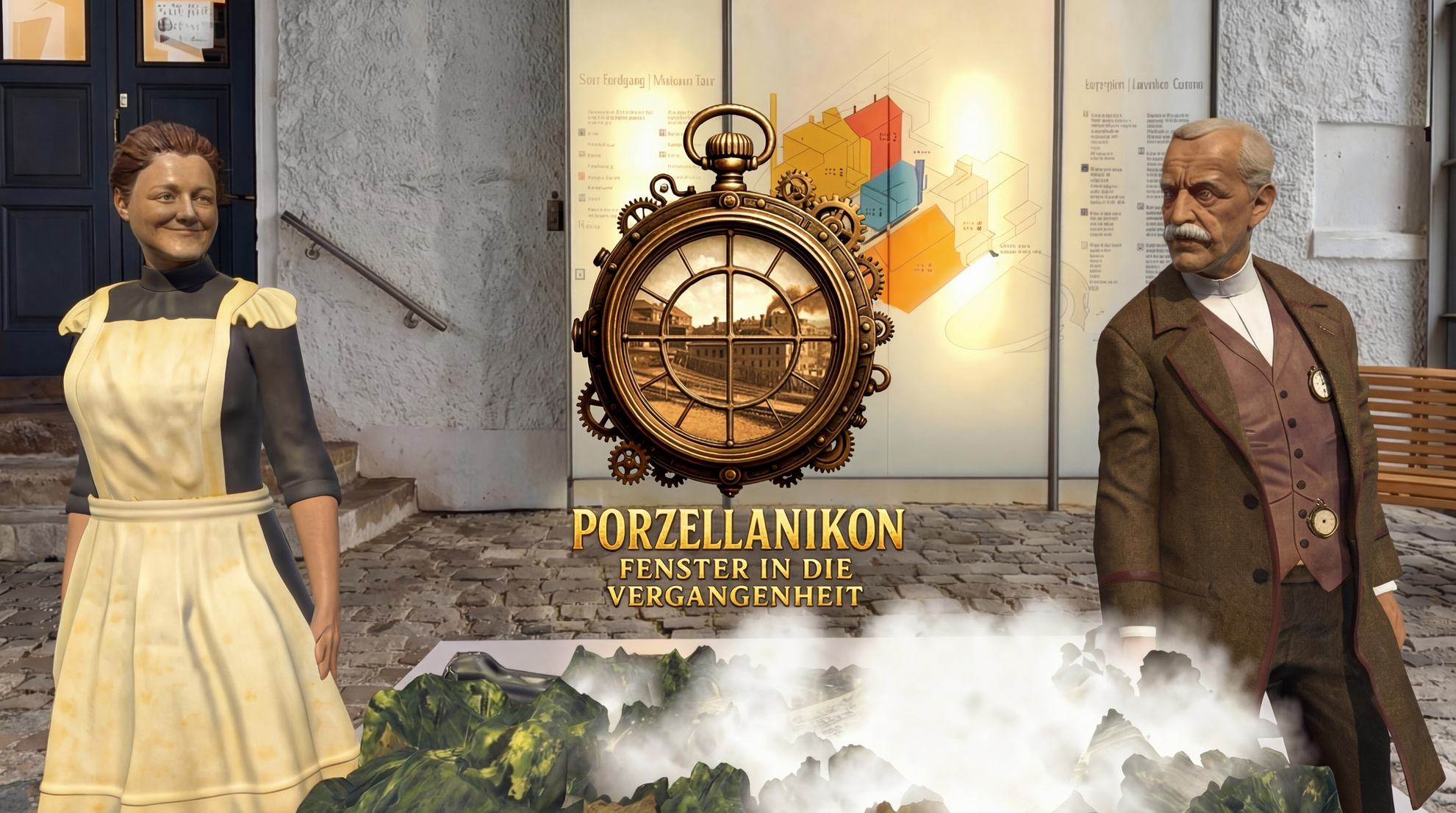
At Porzellanikon in Selb, history doesn’t just sit behind glass. The museum is Europe’s largest porcelain museum, housed in former Rosenthal factory buildings where visitors usually explore porcelain design, production and workers’ lives through classic exhibitions, live demos and workshops.
With the interactive, gamified 3D AR experience „Fenster in die Vergangenheit“ (Window into the Past), the museum and ZAUBAR turn this historic factory complex into a walkable story-driven tour. Visitors roam the grounds with a tablet or their own smartphone, unlocking stations, solving small challenges and watching the 1920s factory rise again, precisely over the ruins in front of them.
Stepping into 1929
The journey starts in the Windfang, the small entrance hall. Staff hand over a preloaded tablet, or visitors open the Porzellanikon app powered by ZAUBAR. One scan later, the quiet courtyard outside looks completely different on screen: trains rattle in with coal and kaolin, chimneys smoke, workers hurry across the yard.
From that moment, the device acts as both time machine and compass. Guests can drift into the factory courtyard and production halls or wander toward the workers’ housing colony. Wherever they go, AR scenes are anchored exactly to the site: kiln houses grow back to full height, invisible interiors become visible again, rooms that no longer exist reappear as 3D spaces with sound and dialogue tied to the surviving architecture. The tour is self-guided, so it feels less like following a route and more like walking through a graphic novel pinned to a real location.
Rosenthal, Martha and life at the factory
Two AR characters keep visitors company: Philipp Rosenthal senior, the ambitious factory owner, and Martha, a plank-carrying porcelain worker with a sharp tongue.
Rosenthal proudly talks about modern infrastructure, private rail lines, efficient kilns and the “social” housing he has created. Martha quietly dismantles that version of events, pointing to cramped workers’ apartments, rent taken straight from wages and the constant fear of losing both job and home. At the gatehouse, an AR time clock appears and the working day suddenly becomes brutally precise: arrive late, lose pay, get written up. At the porcelain shard heap, the Scherbenhaufen, the tour shows in one image what piecework meant: a single cracked plate and an entire chain of workers goes unpaid.
The finale takes place at the round kiln ruins. A low ring of bricks on the ground becomes, in AR, a towering 3D kiln. A virtual kiln master walks visitors through firing stages, temperatures and the labour behind each batch. You are standing in the present, but your screen insists you are inside a glowing industrial machine in 1929. Small in-app games and quizzes along the way turn listening into doing, while Selblinge – tiny AR porcelain spirits – pop up to be collected and reward the curious with extra snippets of story.
What ZAUBAR built to make it possible
Behind the scenes, ZAUBAR developed a multi-station, location-based AR exhibition designed to run long-term across the factory grounds. Content is delivered through the Porzellanikon app and the ZAUBAR AR platform, which handle 3D reconstructions, animated avatars, audio narration and interactive logic. AR scenes are anchored using visual positioning and lightweight triggers so that the right content appears at the right ruin, gate, track or kiln, reliably, day after day.
Accessibility and flexibility were central to the brief. The experience runs on museum tablets or on visitors’ own iOS and Android devices, in German and English, with subtitles and audio. The museum team can update content and tweak details through ZAUBAR’s backend without rebuilding the app, turning the AR layer into an ongoing storytelling tool rather than a one-off showpiece.
Why this kind of AR matters
Fenster in die Vergangenheit is not just about dropping a 3D model into the right place. It tackles a deeper challenge many heritage sites share: how to communicate processes, atmospheres and power structures that are no longer visible in the room.
By letting visitors stand in a quiet ruin while seeing it full of smoke, heat and people, the AR tour makes the factory’s past tangible in a way text panels rarely can. And by pairing a proud owner with a critical worker, then wrapping everything in games, quizzes and Selblinge, it keeps audiences entertained long enough for the nuance to land – and lets them feel the past instead of only reading about it.



.svg)
.svg)
.svg)
.svg)

%201.svg)

.webp)


