

.webp)


.svg)

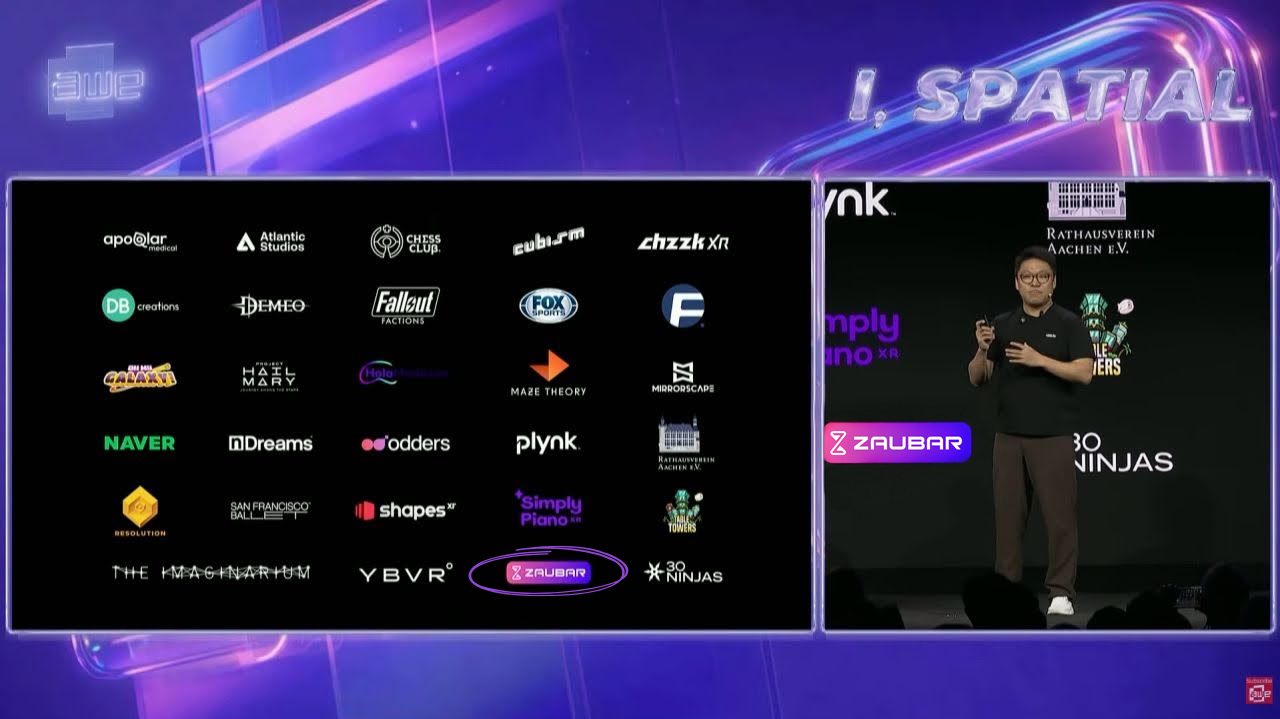
XREAL has officially introduced XREAL AURA, its next-generation optical see-through XR glasses powered by Android XR and built with Qualcomm’s Snapdragon Reality Elite platform.
As part of the growing XREAL AURA ecosystem, ZAUBAR and the Rathausverein Aachen are developing a first-of-its-kind location-based AR experience in Aachen’s historic city centre. The project will transform the area around the Krönungssaal in Aachen City Hall into an immersive journey through the city’s imperial history, with an on-site launch currently targeted for mid-2027.
We are excited to contribute our expertise in location-based immersive storytelling to a new generation of lightweight XR devices.
The Challenge: Connecting Digital History to Real Places
Historical sites contain stories that cannot always be seen in the architecture that remains today.
Visitors may stand in a place where important events unfolded, while the people, environments and historical context behind those events remain difficult to imagine. Traditional exhibitions can provide valuable information, but they often separate the content from the original location.
Location-based XR offers another approach. Digital reconstructions, animations and historical narratives can be placed directly within the physical environment, allowing visitors to explore the past while remaining connected to the real place around them.
However, creating these experiences for outdoor and public environments requires more than compelling content. Developers need lightweight hardware, reliable spatial tracking, natural interaction and a platform capable of supporting detailed, context-aware applications.
The Solution: Experiencing Aachen’s Imperial Heritage Through XR
Together with the Rathausverein Aachen, ZAUBAR is creating an immersive experience centred around the Krönungssaal, or Coronation Hall, in Aachen City Hall.
The location is closely connected to Aachen’s imperial heritage, including Aachen Cathedral and the former Carolingian palace complex. Through XREAL AURA, visitors will be able to encounter this history as a spatial, museum-quality exhibition embedded within the historic city centre.
The experience is planned to combine:
- realistic virtual time travel
- historically accurate reconstructions
- lifelike animations
- detailed spatial storytelling
- digital content connected to the real environment
Rather than observing history only through a conventional screen, visitors will be able to experience digital scenes in relation to the architecture and locations that shaped the story.
Why XREAL AURA Matters for Location-Based Experiences
XREAL AURA combines optical see-through displays with Android XR and a dedicated spatial computing architecture.
The announced device features include a 70-degree field of view, a lightweight design of under 95 grams, world-facing sensors, hand tracking and six-degrees-of-freedom tracking. Its split-compute architecture combines the Snapdragon Reality Elite platform with XREAL’s X1S spatial coprocessor to support responsive and stable XR experiences.
For location-based storytelling, optical see-through glasses are particularly relevant because visitors remain aware of their surroundings. They can continue to see the streets, buildings and people around them while digital elements appear within the physical space.
This creates an opportunity to make immersive content feel like part of a location rather than an experience viewed separately from it.
The Platform: Building for the Android XR Ecosystem
XREAL AURA is powered by Android XR and includes integration with Google’s Gemini. It is being developed in collaboration with Google and Qualcomm Technologies as part of a broader ecosystem for spatial computing.
Through the Android XR Catalyst Developer Program, hundreds of XREAL AURA developer kits are being distributed to developers around the world. XREAL also reports that more than one hundred applications created specifically for XR are already in development across entertainment, productivity, gaming, learning, healthcare and enterprise.
For ZAUBAR, this ecosystem provides an important foundation for bringing location-aware immersive experiences to next-generation XR devices.
Our work focuses on connecting digital stories to physical places. A shared platform for XR development can make it easier to create, test and deploy these experiences across cultural institutions, historic sites and public spaces.
The Impact: A New Way to Encounter Cultural Heritage
The Aachen project demonstrates how spatial computing can support a more direct relationship between history and place.
A historic building can reveal an earlier version of itself. Digital characters can guide visitors through past events. Architectural details can be reconstructed at their original scale and position. Stories that are no longer physically visible can return to the location where they happened.
The goal is not to replace the real environment, but to help visitors understand it more deeply.
By combining XREAL AURA with ZAUBAR’s location-based storytelling technology, we are working toward an experience in which digital content, historical research and physical surroundings become part of one connected journey.
We are grateful to XREAL for featuring the Aachen project among the global partners building for XREAL AURA, and we look forward to sharing more about the experience as development progresses.



.svg)
.svg)
.svg)
.svg)

%201.svg)

.webp)


